Skip to content

Atomic and Molecular Physics Homework 1

Chasse_neige

Question 1

The eigenfunctions of a Hydrogen are of the form ψnlm=Rnl(r)Plm(cosθ)eimϕ

(a) Write down the explicit forms of ψ100, ψ200, ψ210 and ψ21±1.

Rnl(r)=(2na0)3(nl1)!2n[(n+l)!]er(na0)(2rna0)lLnl12l+1(2rna0)

Where

Lkα(x)=j=0k(1)j(k+αkj)xjj!

And

Ylm(θ,ϕ)=2l+14π(lm)!(l+m)!Plm(cosθ)eimϕ

Where

Plm(x)=(1)m(1x2)m2dmdxmPl(x)

So

ψ100=R10(r)Y00(θ,ϕ)=(2a0)312era0L01(2ra0)14πP00(cosθ)=2a03214πera0ψ200=R20(r)Y00(θ,ϕ)=(22a0)318er2a0L11(ra0)14πP00(cosθ)=122a03214π(2ra0)era0ψ210=R21(r)Y10(θ,ϕ)=1a03124er2a0ra0L03(ra0)34πP10(cosθ)=122a03214πra0er2a0cosθψ21±1=R21(r)Y1±1(θ,ϕ)=1a03124er2a0ra0L03(ra0)34π21P1±1(cosθ)ei±1ϕ

Show the two functions respectively

ψ211=14a03214πra0er2a0sinθeiϕψ211=14a03214πra0er2a0sinθeiϕ

(b) Calculate spatial dependence of the probability current J=2μi(ψψψψ) of ψnlm. Describe and sketch distribution of J for ψ200, ψ210 and ψ211.

The probability current

Jnlm=2μi(ψnlmψnlmψnlmψnlm)=2μi2imrsinθ(ψnlmψnlm)e^ϕ=mμrsinθ|ψnlm|2e^ϕ

For ψ200 and ψ210

J=0

For ψ211

J(r,θ,ϕ)=μr64πa05era0sinθe^ϕ

(c) Use the probability current obtained above to show that the z-component of the magnetic moment of ψnlm is given by Mz=mμB where μB=e2μ is the Bohr magneton.

Mz=e2r×Jdv=em2μ|ψnlm|2rsinθrsinθdv=mμB

Question 2

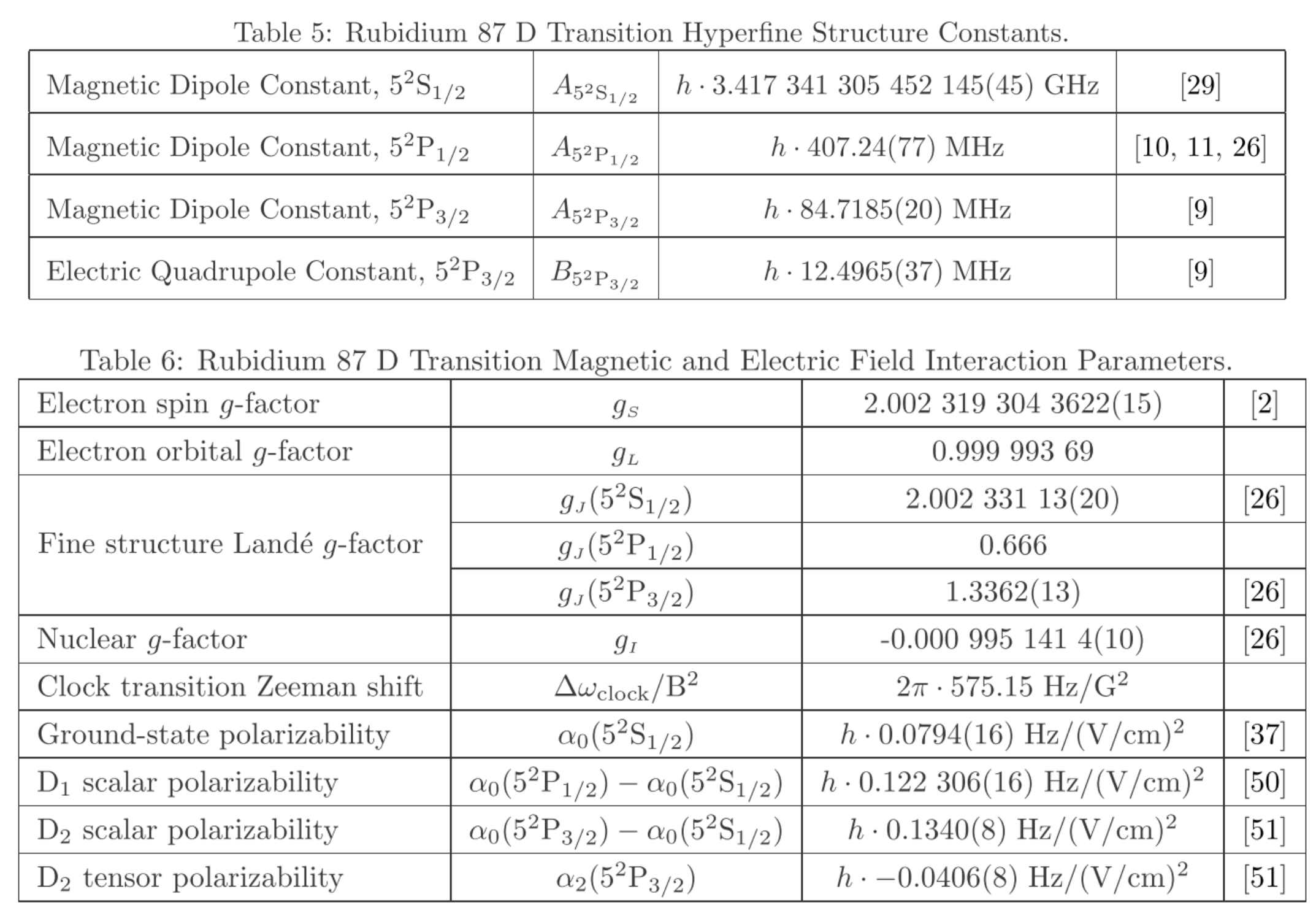
Using HhfB=AIJ+μB(gJJz+gIIz)Bz, compute the hyperfine structure of the 5S1/2 ground state of 87Rb atom under the influence of an external magnetic field. The relevant parameters are given in the next page.

(a) You should write a Matlab or Mathematica script or any computation script of your preference. Use |J,mJ|I,mI as your starting basis to obtain the matrix representation of HhfB and then diagonalize this matrix to obtain the eigenenergies and eigenstates. Do not use the Breit-Rabi formula. Submit your results together with 1 page of your program.

Under the |J,mJ|I,mI basis, the Hamiltonian can be represented as

HhfB=A(I+J+IJ+2+IzJz)+μB(gJJz+gIIz)Bz

For 87Rb atoms' 5S1/2 state

mJ=12,12mI=32,12,12,32

Using the basis of

|mJ=12|mI=32,|mJ=12|mI=12|mJ=12|mI=12,|mJ=12|mI=32|mJ=12|mI=32,|mJ=12|mI=12|mJ=12|mI=12,|mJ=12|mI=32

The Hamiltonian matrix can be obtained as

Hij=Ai|I+J+IJ+2+IzJz|j+μB(gJJz+gIIz)Bz

For diagonals, the x and y components of the spin operator is 0, so the Hamiltonian is

Hii=AmJimIi+μB(gJmJi+gImIi)Bz

For non-diagonals,the x and y components of the spin operator is non-zero only if the spin state

I+J|j=|i

or

IJ+|j=|i

The Hamiltonian therefore equals

Hij={A2I(I+1)(mIj(mIj+1))J(J1)(mJj(mJj1))(I+J|j=|i)A2I(I+1)(mIj(mIj1))J(J+1)(mJj(mJj+1))(IJ+|j=|i)

The Matlab script for calculating the Hamiltonian is as follows

matlab
% 参数
A = 3.417341305452145; % GHz * h
g_J = 2.00233113;
g_I = -0.0009951414;
mu_B = 0.001399624; % GHz/G * h
B_z = 0.001; % G

% 基矢状态
states = [
    -0.5, -1.5;
    -0.5, -0.5;
    -0.5,  0.5;
    -0.5,  1.5;
     0.5, -1.5;
     0.5, -0.5;
     0.5,  0.5;
     0.5,  1.5
];

%哈密顿量
N = 8;
H = zeros(N);

for i = 1:N
    mJ_i = states(i,1);
    mI_i = states(i,2);
    % 对角元
    H(i,i) = A * mJ_i * mI_i + mu_B * B_z * (g_J * mJ_i + g_I * mI_i);
    
    for j = i+1:N
        mJ_j = states(j,1);
        mI_j = states(j,2);
        
        % 检查非对角元条件
        if mJ_i - mJ_j == -1 && mI_i - mI_j == 1 % I_+ J_- 情况
            factor = sqrt( (1/2)*(3/2) - mJ_j*(mJ_j-1) ) * sqrt( (3/2)*(5/2) - mI_j*(mI_j+1) );
            H(i,j) = 1/2 * A * factor;
            H(j,i) = H(i,j);
        elseif mJ_i - mJ_j == 1 && mI_i - mI_j == -1 % I_- J_+ 情况
            factor = sqrt( (1/2)*(3/2) - mJ_j*(mJ_j+1) ) * sqrt( (3/2)*(5/2) - mI_j*(mI_j-1) );
            H(i,j) = 1/2 * A * factor;
            H(j,i) = H(i,j);
        end
    end
end

%对角化
[V, D] = eig(H);
eigenvalues = diag(D);
[eigenvalues_sorted, sort_idx] = sort(eigenvalues);
eigenvectors_sorted = V(:, sort_idx);

The results show that the Matrix representation of the Hamiltonian is (when the magnetic field is 0)

HB=0=(2.563000000000.854002.96000000.854003.417000002.563002.96002.96002.563000003.417000.854000002.96000.854000000002.563)

The eigenvector matrix is

VB=0=(00010000000.500.86600000.7070000.707000.866000000.50000.86600.500000.7070000.707000.5000000.866000000001)

and the eigenvalue matrix is

DB=0=(4.272000000004.272000000004.272000000002.563000000002.563000000002.563000000002.563000000002.563)

(b) When B=0, write down all |F,mF states in the basis of |J,mJ|I,mI from your computations. Compare your results to that based on the Clebsch-Gordan coefficients? Compare also the eigenenergies you obtain to the formula given in the lecture notes.

|F=1,mF=1=0.500|mJ=12|mI=12+0.866|mJ=12|mI=32|F=1,mF=0=0.707|mJ=12|mI=12+0.707|mJ=12|mI=12|F=1,mF=1=0.866|mJ=12|mI=320.500|mJ=12|mI=12|F=2,mF=2=|mJ=12|mI=32|F=2,mF=1=0.866|mJ=12|mI=12+0.500|mJ=12|mI=32|F=2,mF=0=0.707|mJ=12|mI=120.707|mJ=12|mI=12|F=2,mF=1=0.866|mJ=12|mI=320.500|mJ=12|mI=12|F=2,mF=2=|mJ=12|mI=32

For the results given by the Clebsch-Gordan coefficients,
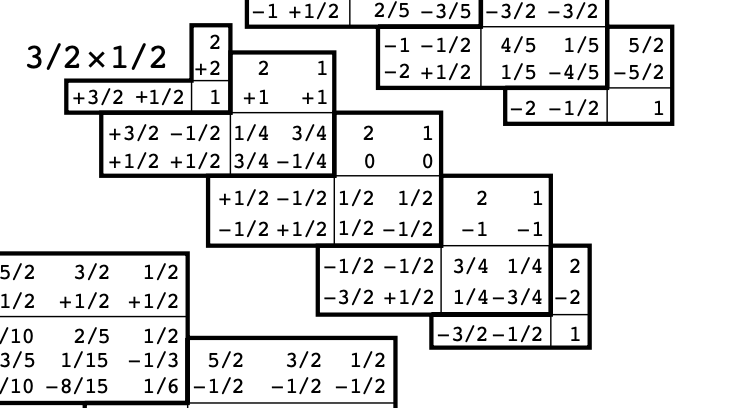
image-20251009000608068

We can see from the table that

|F=1,mF=1=32|mJ=12|mI=32+12|mJ=12|mI=12|F=1,mF=0=12|mJ=12|mI=12+12|mJ=12|mI=12|F=1,mF=1=32|mJ=12|mI=32+12|mJ=12|mI=12|F=2,mF=2=|mJ=12|mI=32|F=2,mF=1=32|mJ=12|mI=12+12|mJ=12|mI=32|F=2,mF=0=12|mJ=12|mI=12+22|mJ=12|mI=12|F=2,mF=1=32|mJ=12|mI=3212|mJ=12|mI=12|F=2,mF=2=|mJ=12|mI=32

are exactly the same as those we've calculated apart from some signs of the whole eigenvectors.

For the eigenenergies when B=0, the script gives that there are two possible values

E=h4.272GHz,E+=h2.563GHz

The formula given in the lecture notes show that

H=AIJ=AF(F+1)I(I+1)J(J+1)2

When F=1

H=A2154342=1.25A=h4.272GHzE

When F=2

H+=A6154342=0.75A=h2.563GHzE+

These show that our calculations are corresponding to the formula given in class.

Hint for Question 2:
IJ=I+J+IJ+2+IzJzimage-20250929134001198

Built with VitePress