Skip to content

Atomic and Molecular Physics Homework 4

Chasse_neige

Question1

A helium atom is excited from the ground state to the autoionizing state 2s4p by absorption of ultraviolet light. Assume the 2s electron moves in the unscreened Coulomb field of the nucleus and the 4p electron in the fully screened Coulomb field of 1r. (a) Obtain the energy of this autoionizing level and the corresponding wavelength of the UV radiation.

The Hamiltonian is

H=H0+H

where

H0=12r122r12r221rH=1r12

So the Schrödinger equation gives that the zero-order wavefunction takes the form of

ψ(0)(r1,r2)=ψ2s(Z=2)(r1)ψ4p(Z=1)(r2)En1n2(0)=Z122n12Z222n22=422142=1716

So we get the zero-order energy

E2s4p(0)=1716μc2α2=1716mempme+mpc2α214.4481802eV

For the first-order perturbation of the energy, consider the perturbation of the Hamiltonian

Hψ=ΔEψ

Let

ψ=au2s(1)u4p(2)+bu2s(2)u4p(1)

and we'll get

(JKKJ)(ab)=ΔE(ab)

Where the parameters is the direct integral

J=e24πϵ0u2s(1)u2s(1)1r12u4p(2)u4p(2)d[3]r1d[3]r2

and the exchange integral

K=e24πϵ0u2s(1)u4p(2)1r12u2s(2)u4p(1)d[3]r1d[3]r2

Given that the factor 1r12 can be expanded by the spherical harmonic functions

1r12=l=0r<lr>l+1Pl(cosθ12)

Using the specific form of the radial wavefunction

u2s(r)=2a032(1ra0)era0u4p(r)=125615a032er4a0ra0(r2a0220ra0+80)

Because these integrals are nearly impossible to be calculated by hand, so I'll use mathematica to give a numerical answer:

mathematica
ClearAll["Global`*"]

R[Z_, n_, l_, r_] := Module[{rho, Nnorm}, rho = (2 Z r)/n;
   Nnorm = Sqrt[(2 Z/n)^3*(n - l - 1)!/(2 n*(n + l)!)];
   Nnorm*Exp[-rho/2]*rho^l*LaguerreL[n - l - 1, 2 l + 1, rho]];

SlaterIntegral[k_, Z1_, n1_, l1_, Z2_, n2_, l2_, Z3_, n3_, l3_, Z4_, 
   n4_, l4_] := 
  Module[{integrand, r1, r2, radialPart1, radialPart2, result}, 
   result = 
    Integrate[
     r1^2*R[Z1, n1, l1, r1]*
      R[Z3, n3, l3, 
       r1]*(Integrate[
         r2^2*R[Z2, n2, l2, r2]*
          R[Z4, n4, l4, r2]*(r2^k/r1^(k + 1)), {r2, 0, r1}] + 
        Integrate[
         r2^2*R[Z2, n2, l2, r2]*
          R[Z4, n4, l4, r2]*(r1^k/r2^(k + 1)), {r2, r1, 
          Infinity}]), {r1, 0, Infinity}, Assumptions -> {r1 > 0}];
   Return[result];];

Z2s = 2; n2s = 2; l2s = 0;
Z4p = 1; n4p = 4; l4p = 1;

J = SlaterIntegral[0, Z2s, n2s, l2s, Z4p, n4p, l4p, Z2s, n2s, l2s, 
   Z4p, n4p, l4p];

K = SlaterIntegral[1, Z2s, n2s, l2s, Z4p, n4p, l4p, Z4p, n4p, l4p, 
   Z2s, n2s, l2s];

Print[J];
Print[K];

The script gives out that

J=2298293906250e24πϵ0a01.60102eV

and

K=89179521220703125e24πϵ0a00.198795eV

So we can get that the first-order energy correction

ΔE1=J+K0.0661418e24πϵ0a01.79981eVΔE2=JK0.0515306e24πϵ0a01.40222eV

So the energy for the this autoionizing level at singlet and triplet states are

Etriplet=12.6483699eVEsinglet=13.0459601eV

For the ground state where the two electrons are at the 1s state, the energy is

E1s2(0)=2212mempme+mpc2α2108.786298eV

while the first-order correction gives out that

J=34.0142328eVK=0

So the energy for the ground state is

Eground108.786298eV+34.0142328eV74.772065eV

So the energy gap between the ground state and this exited state is

ΔEtriplet=EtripletEground=12.6483699eV+74.772065eV62.1236951eVΔEsinglet=EsingletEground=13.045960eV+74.772065eV61.726105eV

So the wavelength of the UV radiation are

λtriplet=hcΔEtriplet19.96nmλsinglet=hcΔEsinglet20.09nm

(b) Find the velocity of the electron emitted in the autoionizing process in which the autoionizing level 2s4p decays into a free electron and a HeA+ ion in the ground state 1s.

For the HeA+ ion in the ground state 1s, the energy is

E=22212mempme+mpc2α254.39315eV

So the total energy of the emitted electron is

ΔEtriplet=12.6483699eV+54.39315eV41.74478eVΔEsinglet=13.045960eV+54.39315eV41.34719eV

Therefore, the velocity of the emitted electron is

vtriplet3.832×106m/svsinglet3.814×106m/s

Question2

Consider the ground state of zirconium which has a ground state’s term symbol of 3F2. (a) Determine electron configuration of all 40 electrons of Zr.

Zirconium has atomic number 40.

1s22s22p63s23p64s23d104p6

The remaining 4 electrons occupy the 5s and 4d orbitals. Because of the energetic closeness of 5s and 4d, and the extra stability of a filled or half‑filled 4d subshell, the ground‑state configuration is

[Kr]5s24d2

Thus the complete ground‑state electron configuration of Zr is

1s22s22p63s23p64s23d104p65s24d2

(b) According to the given term symbol, what are the spin angular momentum S, the orbital angular momentum L, and the total angular momentum J for the ground state of Zr?

For a term symbol 2S+1LJ:

  • Spin multiplicity 2S+1=3S=1.
  • Orbital symbol FL=3.
  • Total angular momentum J=2.

(c) Determine all possible values of S. Does the ground state of Zr meet the requirement of Hund’s first rule? Explain your answer.

The valence electrons that determine the term are the two 4d electrons (the closed shells and the filled 5s subshell contribute S=0,L=0). For two electrons, the total spin quantum number S can be

S=|s1s2|,|s1s2+1|,,|s1+s2|=0or1

Hund’s first rule states that for a given electron configuration, the term with the highest multiplicity (largest S) lies lowest in energy. Here the ground state has S=1 , which is the maximum possible S for the 4d2 configuration.

(d) Determine all possible values of L by adding all the individual angular momenta li. Does the ground state of Zr meet the requirement of the second Hund's rule? Explain your answer.

Each 4d electron has orbital quantum number l=2. The total orbital angular momentum L can in principle take values from |l1l2| to l1+l2,

L=0,1,2,3,4.

However, or equivalent electrons (same n,l) the Pauli exclusion principle restricts the allowed L values for each total S. For the two 4d electrons with parallel spins (S=1), the allowed L values are L=1,2,3 (states symmetric in spin must be antisymmetric in orbital part, which removes L=0,4 for S=1). Hund’s second rule states that for a given multiplicity, the term with the largest L lies lowest. Given that S=1, the allowed L values are 1,2,3; the largest is L=3, and the ground state indeed has L=3, which is in consistent with the Hund's second rule.

(e) Determine all possible values of the total angular momentum J by coupling of L and S. Does the ground state of Zr meet the requirement of the third Hund’s rule? Explain your answer.

For a given L and S, the total angular momentum J takes values

J=|LS|,|LS|+1,,L+S.

With L=3 and S=1:

J=2,3,4.

Hund’s third rule states:

  • For a subshell less than half filled, the level with the smallest J is lowest.
  • For a subshell more than half filled, the level with the largest J is lowest.

The 4d subshell can hold 10 electrons; here it contains only 2 electrons, so it is less than half filled. Therefore the lowest energy term should have the smallest J: J=|LS|=2. The ground‑state term symbol 3F2 indeed has J=2.

Question3

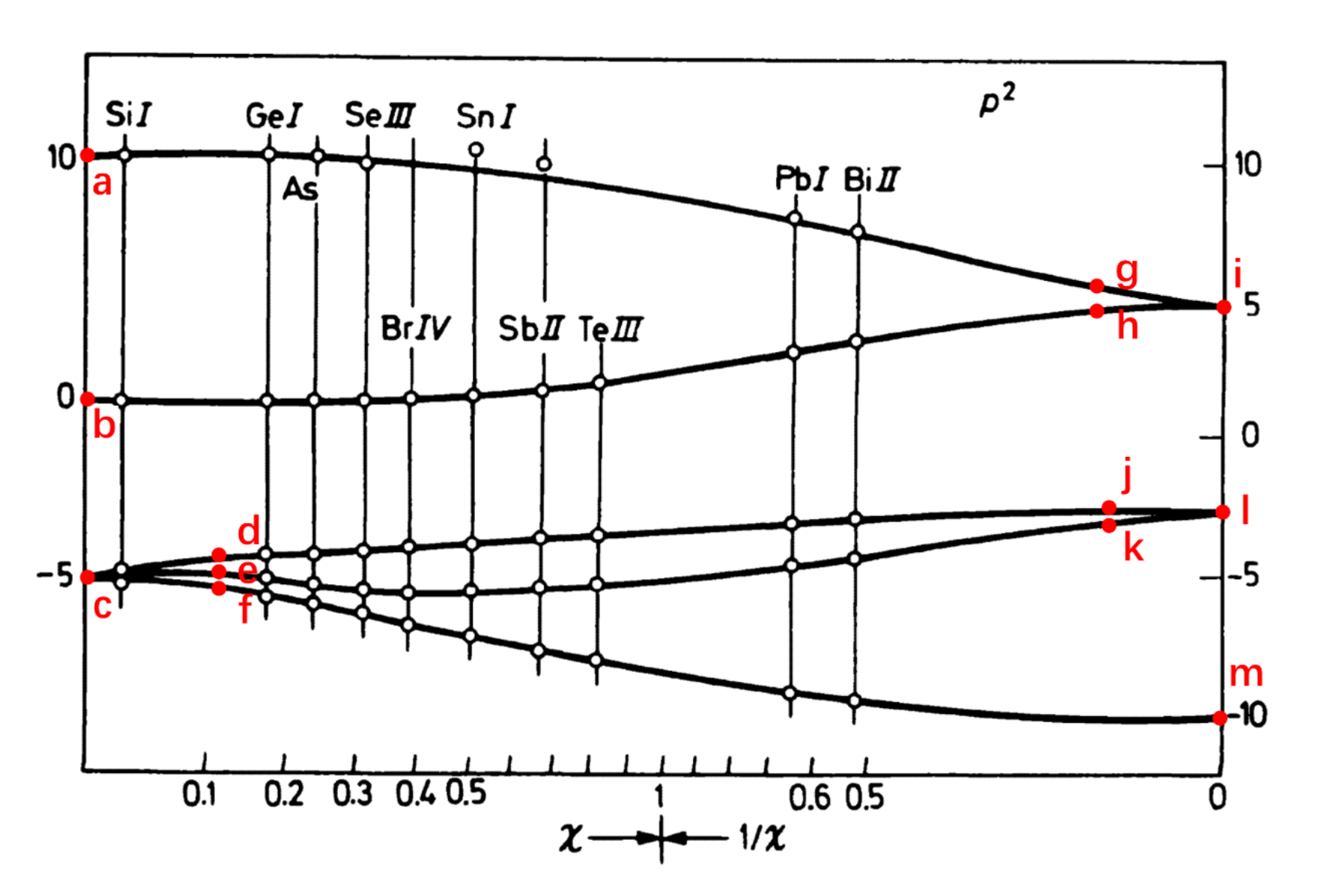
image-20251207181019990

(a) For atoms or ions whose two valence electrons are in the same p-subshell (p2). Consider the effects of LS and jj coupling. Write down the term symbols of the states (a), (b), ..., (m) in the picture below. Explain your answer. (The parameter χ describes the strength of spin orbit coupling. A larger χ means a larger energy H2 discussed in the lecture.)

For left side of the picture, the atomic number is quite low, so it's proper to describe these states using the effect of LS coupling. For the Silicon atoms, the valence electrons are the two 3p2 electrons. So the p2 configuration gives rise to three terms due to electrostatic repulsion and the Pauli exclusion principle: 3P, 1D, and 1S.

According to the Hund's Rules, the ordering of the states are:

  1. 3P is the ground term (lowest energy).

  2. Highest Orbital (L) for same S: 1D is the next lowest.

  3. 1S is the highest energy term.

Considering the Fine Structure Spin-Orbit Splitting:

  1. The 3P term (S=1,L=1) splits into J=0,1,2. For a less-than-half-filled shell, the lowest J has the lowest energy. 3P0<3P1<3P2.

  2. The 1D term (S=0,L=2) has only J=2: 1D2.

  3. The 1S term (S=0,L=0) has only J=0: 1S0.

So the energy order at low χ is 3P0<3P1<3P2<1D2<1S0.

jj Coupling Limit (Right Side): The electrons couple their spin and orbital angular momenta individually (j=l±s). For p electrons (l=1), j can be 1/2 or 3/2.

  1. (1/2,1/2): Both electrons in j=1/2. Lowest energy (spin-orbit favors lower j). Allowed J: 0.

  2. (3/2,1/2): One in j=3/2, one in j=1/2. Intermediate energy. Allowed J: 1, 2.

  3. (3/2,3/2): Both electrons in j=3/2. Highest energy. Allowed J: 0, 2.

States with the same total angular momentum J do not cross (non-crossing rule).So we can connect the levels from left to right based on their energy order for each J.

  1. J=0: Lowest (3P0) Lowest (1/2,1/2)0. Highest (1S0) Highest (3/2,3/2)0.
  2. J=1: Only one state (3P1) Middle group (3/2,1/2)1.
  3. J=2: Lower (3P2) Middle group (3/2,1/2)2. Higher (1D2) Highest group (3/2,3/2)2.

According to the analysis above, we can get the assigned term symbols for the points given:

Left Side (L-S Coupling Region):

(a) 1S0 : The highest energy term on the LHS.

(b) 1D2 : The middle energy term.

(c) 3P: The lowest energy term.

The bottom cluster originates from the 3P term:

(f) 3P0 : The lowest level of the triplet.

(d) 3P2 : The highest level of the triplet.

(e) 3P1 : The middle level of the triplet.

Right Side (j-j Coupling Region): In jj coupling notation (j1,j2)J

(i) (3/2,3/2) : The highest energy state.

(l) (3/2,1/2): The middle energy state.

(m) (1/2,1/2): The lowest energy state, connected to 3P0.

(g) (3/2,3/2)0: The highest state, connected to 1S0.

(h) (3/2,3/2)2 : The second highest state, connected to 1D2.

(j) (3/2,1/2)2 : The upper state of the middle group (J=2), connected to 3P2.

(k) (3/2,1/2)1 : The lower state of the middle group (J=1), connected to 3P1.

Built with VitePress