Atomic and Molecular Physics Homework 3
Chasse_neige
Question 1: Ramsey fringes and atomic clock (50 points)
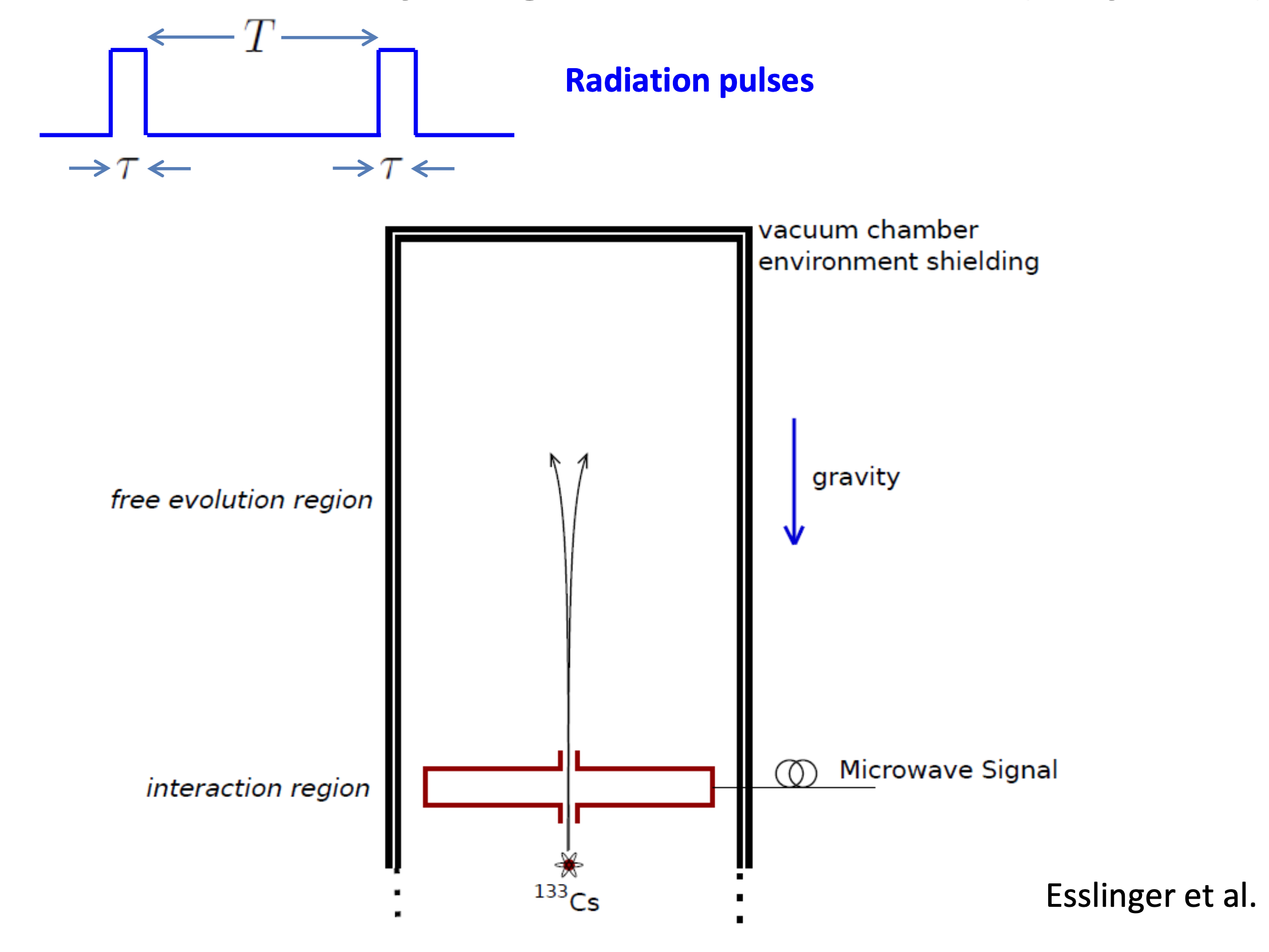
Radiation pulses
At
(a) Represent the evolution of the Bloch vector on the Bloch sphere, and find the vector
such that
Given that the time evolving equation can be represented as
in the rotating frame where
So when it exactly resonances, the Pauli matrix vector will evolve as
After time
in the rotating frame.
(b) After the interaction region, the atom moves freely in the upper part of the clock chamber for a duration of
Represent the evolution of the Bloch vector on the Bloch sphere, and find the vector
In the upper part of the clock chamber, the time evolving equation for the Pauli matrix vector becomes
in the rotating frame.
So in the rotating frame, the vector
(c) Since the atoms fall freely, in this second pass, they spend the same amount of time
The evolvement of the Pauli matrix vector is
After the time
(d) Compute the coordinates of the Bloch vector. Use the result to compute the probability to detect the atom in state
If there exists a detuning of
So after the time
In the free evolving part
before it falls into the interaction region the second time.
In the second pass, the Pauli matrix vector becomes
So after the
So the probability to detect the atom in state
The quality factor equals
Under the circumstance given by the question where the frequency of atomic transition of a cesium atom
Quantum projection noise
There is a fundamental limit to the accuracy at which one can measure the position of the Ramsey fringes, and therefore the precision of the clock. Suppose that we are now working with
By measuring the probability to observe the atom in state
Suppose that I've made
where
So the standard deviation is
The relation between the detected
So the standard deviation of the frequency is
The sensitivity of the clock
Maximum
One could increase the maximum by increasing
Effects of the detuning during the interaction
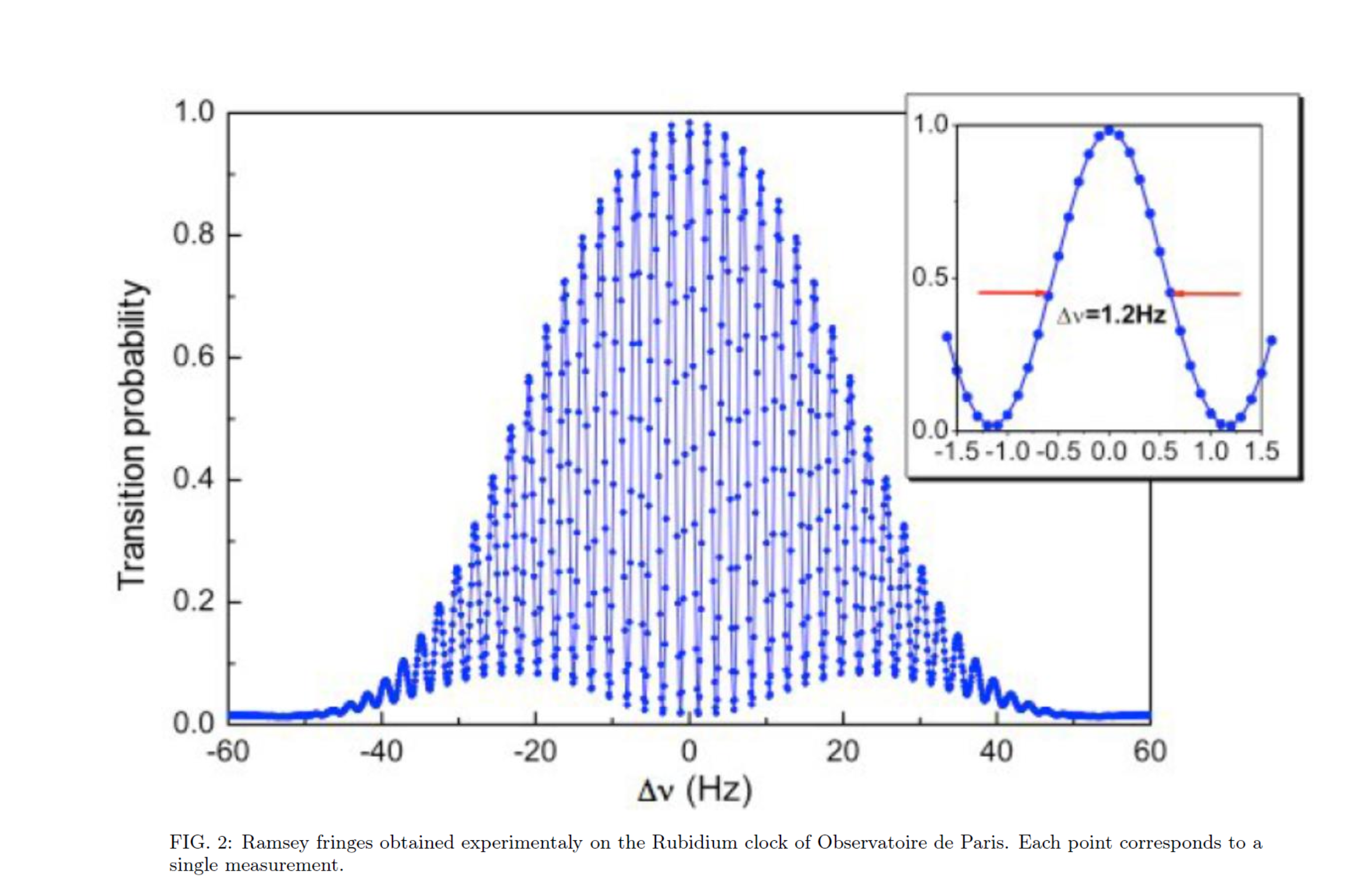
So far we assume that the microwave is on resonance in the interaction area. In fact, when the microwave oscillator is off resonance, the detuning occurs in the interaction area as well. Use 3D rotation matrices in Mathematica to compute the Ramsey fringes including the effects of detuning considering the case where
The Mathematica Script is as follows
TransitionProbability[x_] := Module[
  {rabiFrequency = 14, detuningFrequency = x, totalFrequency,
   interrogationTime = 3, interactionTime, blochVector},
  totalFrequency = Sqrt[rabiFrequency^2 + detuningFrequency^2];
  interactionTime = Pi/(2*rabiFrequency);
  blochVector = {0, 0, 1};

  (*The first Pi/2 pulse*)
  blochVector =
   blochVector .
    RotationMatrix[
     totalFrequency*interactionTime, {rabiFrequency, 0,
      detuningFrequency}];

  (*The interrogation region*)
  blochVector =
   blochVector .
    RotationMatrix[detuningFrequency*interrogationTime, {0, 0, 1}];

  (*The second Pi/2 pulse*)
  blochVector =
   blochVector .
    RotationMatrix[
     totalFrequency*interactionTime, {rabiFrequency, 0,
      detuningFrequency}];

  finalPossibility = (1 - blochVector[[3]])/2;
  finalPossibility
  ]

Plot[TransitionProbability[x], {x, -60, 60}]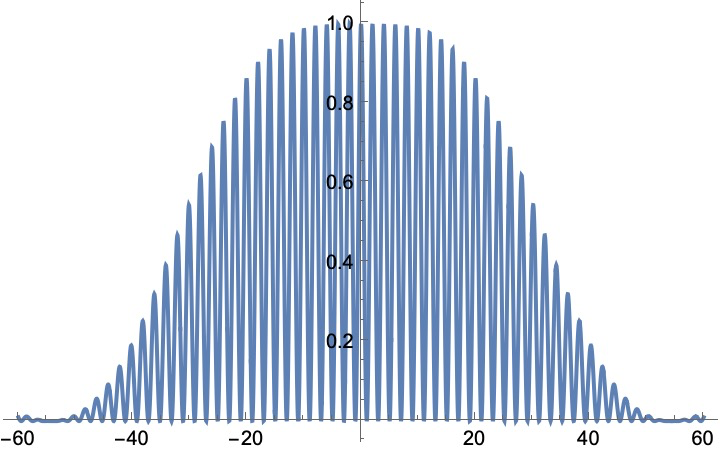
Question 2 (30 points)
(a) The lifetime of the
where
Thus, the linewidth is
(b) Calculate the saturation intensity of Rb
The saturation intensity is defined by
So the saturation intensity equals
(c) A student wants to probe a Rb gas with
Laser intensity,
The ratio
The Rabi frequency
where
Thus, the Rabi frequency is
(d) Estimate the number of photons scattered by one atom per unit time assuming that the laser detuning is 12
Consider
So the scattering rate for a two-level atom is
where:
Compute:
Thus, the scattering rate is around
Question 3: D.C. Stark shift (20 points)
(a) An atom with two levels of energies
where the matrix element for the perturbation
The unperturbed Hamiltonian for the two-level system has energies
The energy eigenvalues are found by solving
Thus, the eigenvalues are
(b) Show that 'weak' fields produce a quadratic Stark effect on the atom, equivalent to the usual second-order perturbation-theory expression for a perturbation
A similar expression can be found for the energy shift
For weak fields,
The unperturbed energies are
In perturbation theory,
which matches the expansion. Similarly,
(c) Estimate the Stark shift for the ground state of a sodium atom in a field of
For the ground state of sodium, the Stark shift is estimated using second-order perturbation theory. The dominant contribution comes from the first excited state, with energy difference
The energy shift for the ground state is
with electric field
Then
Thus, the Stark shift for the ground state of sodium in a field of